
Is Crypto Really Untraceable?
How Investigators Follow Stolen Funds on the Blockchain

It's 2 a.m. A trading platform's hot wallet is drained. Within minutes, millions in crypto scatter across hundreds of addresses, three blockchains and a mixer. On social media, the verdict is instant: "That money is gone forever."
Except it usually isn't.
Crypto has a reputation as the perfect getaway money: invisible, borderless and untraceable. The truth is almost the opposite. Every coin that moves leaves a permanent, public footprint that anyone can inspect and nobody can erase. For investigators, that makes the blockchain less like a hiding place and more like a crime scene that never gets cleaned up.
So how do they actually follow the money? Let's break it down.
Is crypto traceable? Pseudonymous is not anonymous
A crypto wallet address looks like gibberish, something like 0x71C...9A2F. There's no name, no phone number, no home address attached. That's why crypto is called pseudonymous: your identity hides behind a label, but everything that label does is public.
Think of a novelist writing under a pen name. At first, nobody knows who they are. But every book sits on a public shelf, and each one adds clues: writing style, settings, the publisher they use. Eventually, one slip connects the pen name to a real person, and suddenly the whole catalogue has an author.
Blockchains work the same way. Every transaction permanently records who sent funds (by address), how much, and when. The moment a single address is tied to a real identity, for example through a withdrawal to an exchange that verified the user's ID, its entire history lights up, past and future.
How investigators turn wallets into suspects
A single transaction tells you almost nothing. The magic of blockchain tracing happens when thousands of them are connected into a story. Investigators do this with three big ideas.
1. Clustering: one owner, many wallets. Nobody uses just one address. Analysts group addresses that likely belong to the same person or business. A classic clue on Bitcoin: when several addresses are spent together in one transaction, they almost always share an owner, because each one needed its private key to sign.
2. Labelling: putting names on the map. Clusters are matched to known players: exchanges, payment services, DeFi protocols, mixers, sanctioned wallets and addresses tied to past scams. A random string becomes "Exchange X deposit wallet" or "linked to a known phishing campaign."
3. Following the flow. Once wallets have names, the blockchain stops looking like noise and starts looking like a map. Investigators can finally ask the questions that matter:
Where did this money come from? Where did it go next? Who is about to cash out?
5 tricks used to hide crypto, and why they still leave a trail
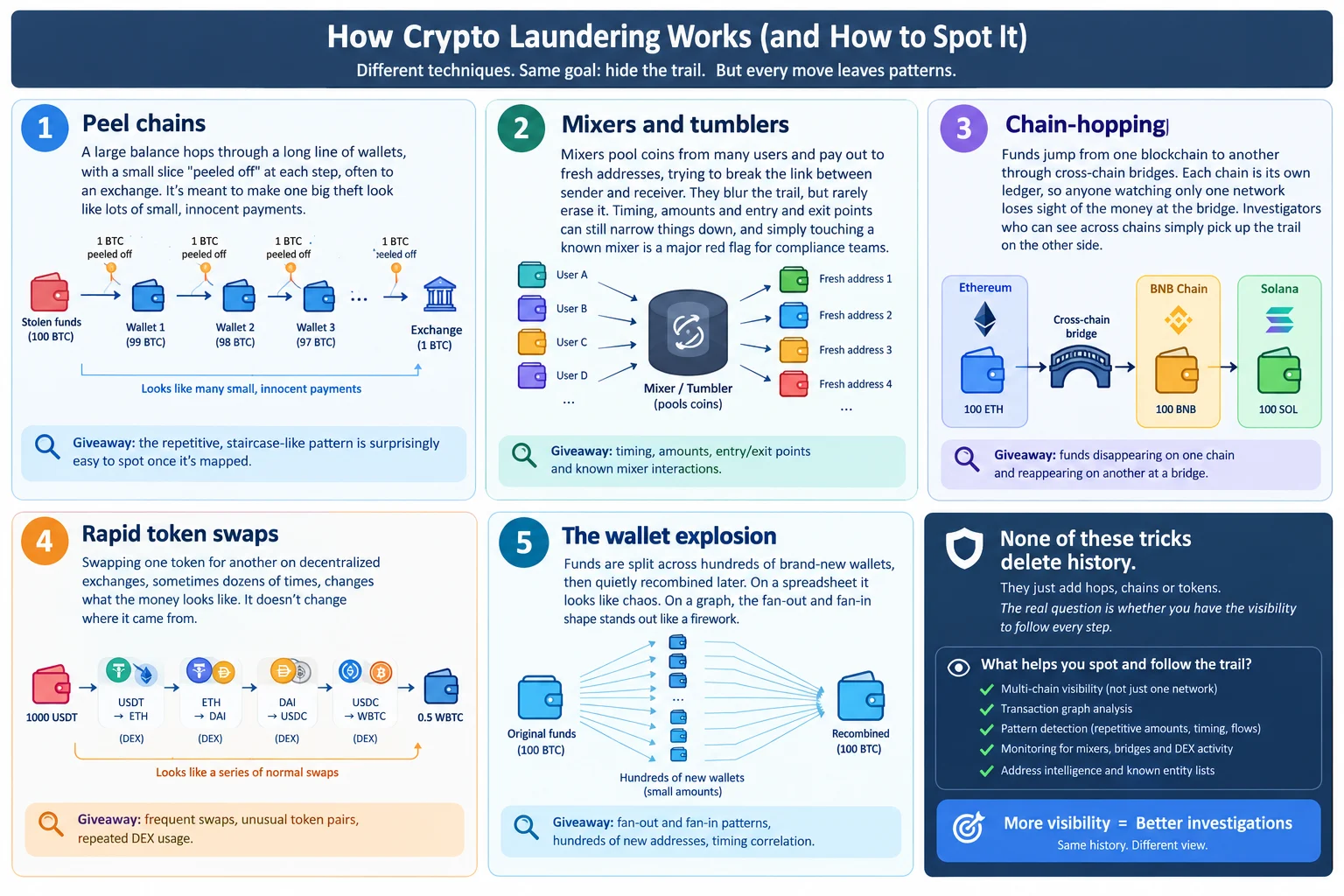
People moving illicit funds know the ledger is public, so they try to muddy the water. Here's what investigators see most often, and the fingerprint each trick leaves behind.
1. Peel chains
A large balance hops through a long line of wallets, with a small slice "peeled off" at each step, often to an exchange. It's meant to make one big theft look like lots of small, innocent payments. The giveaway? That repetitive, staircase-like pattern is surprisingly easy to spot once it's mapped.
2. Mixers and tumblers
Mixers pool coins from many users and pay out to fresh addresses, trying to break the link between sender and receiver. They blur the trail, but rarely erase it. Timing, amounts and entry and exit points can still narrow things down, and simply touching a known mixer is a major red flag for compliance teams.
3. Chain-hopping
Funds jump from one blockchain to another through cross-chain bridges. Each chain is its own ledger, so anyone watching only one network loses sight of the money at the bridge. Investigators who can see across chains simply pick up the trail on the other side.
4. Rapid token swaps
Swapping one token for another on decentralized exchanges, sometimes dozens of times, changes what the money looks like. It doesn't change where it came from.
5. The wallet explosion
Funds are split across hundreds of brand-new wallets, then quietly recombined later. On a spreadsheet it looks like chaos. On a graph, the fan-out and fan-in shape stands out like a firework.
Every one of these tricks adds hops, chains or tokens. None of them deletes history. The real question is whether you have the visibility to follow every step.
So why isn't every case solved overnight?
If all the data is public, why do investigations still drag on for weeks? Because public doesn't mean usable.
The pieces live in different places. On-chain records sit on one set of tools, market prices on another, entity labels on a third. Investigators often juggle a dozen disconnected dashboards and spend hours copying addresses between browser tabs, while the funds keep moving. Add multiple blockchains, each with its own data format, and the blind spots multiply.
For compliance teams, those blind spots aren't just inconvenient. A missed link to a high-risk wallet can mean regulatory trouble and real financial losses. The challenge today isn't finding blockchain data. It's connecting it fast enough to act.
The trail is there. The question is whether you can see it.
Remember that 2 a.m. wallet drain? The funds didn't vanish. They left a trail across wallets, mixers and blockchains. What decides whether that trail leads somewhere is how clearly you can see it, and how fast.
That's exactly why we built Nodestors. Instead of a dozen disconnected tools, Nodestors gives investigators, compliance teams and institutions one connected view of the digital-asset world. Our Wallet Intelligence System follows the movement of funds across chains and helps surface fraudulent activity before it turns into a loss.
Crypto was never invisible. With the right lens, it's one of the most transparent financial systems ever built.
Ready to see the full picture? Let's connect or email us at info@nodestors.com.
This article is for educational purposes only and does not constitute financial, investment, legal or technical advice.


